
The fiber vs CO2 laser cutter question comes up for almost every shop buying its first or next machine. Both cut, both are precise, but they use different technology and shine in different work. Pick the wrong one and you fight the machine on every job; pick the right one and it pays for itself in clean parts and uptime. This guide compares a fiber vs CO2 laser cutter across the things that actually matter on the floor: materials, speed, running cost, and maintenance.
Table of Contents
- Fiber vs CO2 Laser Cutter: The Core Difference
- Materials and Thickness
- Speed and Efficiency
- Running Cost and Maintenance
- Which One Is Right for Your Shop?
- Frequently Asked Questions
Key Takeaways
- Fiber lasers create the beam in a solid source; CO2 lasers use a gas-filled tube.
- Fiber wins on metal, especially thin to mid-gauge sheet and reflective metals.
- CO2 still suits thick non-metals and certain organic materials.
- Fiber is more energy efficient and has fewer wear parts to maintain.
Fiber vs CO2 Laser Cutter: The Core Difference
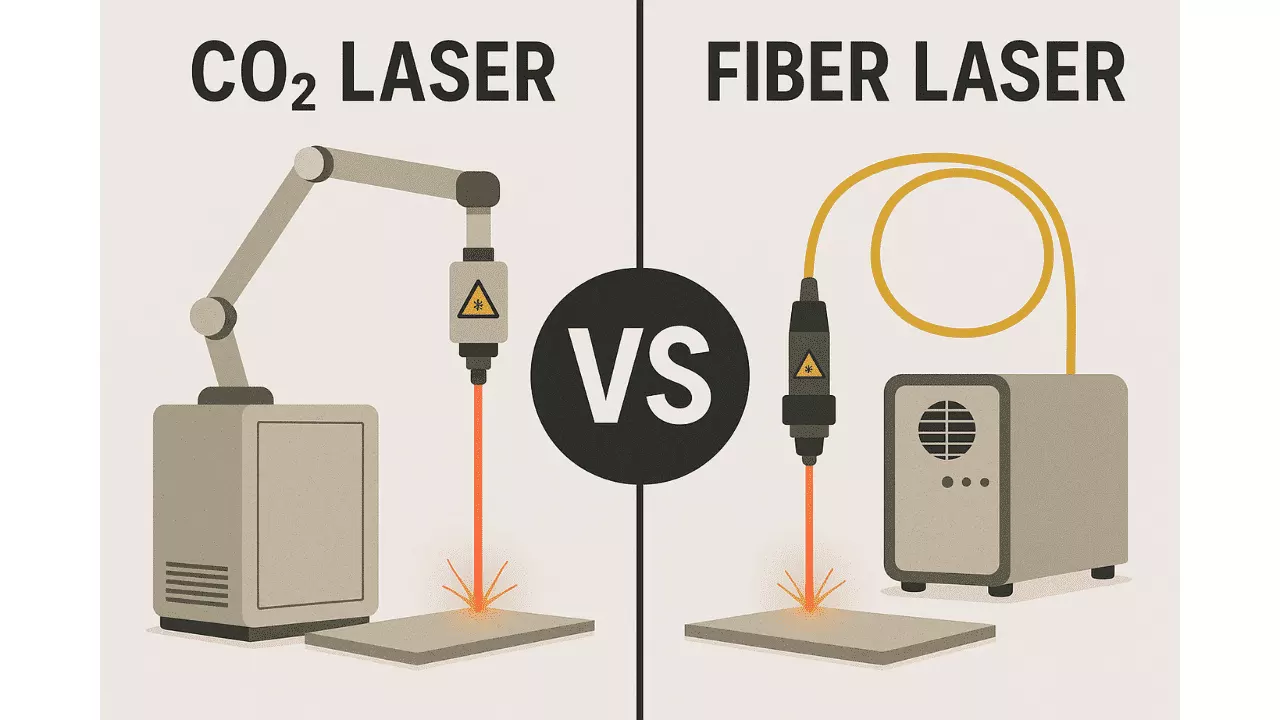
The difference starts with how each makes its beam. A fiber laser generates light in a solid fiber source and delivers it through a cable, with no mirrors to align. A CO2 laser excites a gas-filled tube and steers the beam with mirrors. That single design choice ripples through everything else: the fiber’s wavelength is absorbed far better by metal, while CO2’s longer wavelength does better on non-metals. So the fiber vs CO2 laser cutter decision is really a question of what you cut most.
Materials and Thickness
Fiber lasers cut mild steel, stainless, aluminum, brass, and copper, and they handle reflective metals that can trouble a CO2 machine. They are strongest on thin and mid-gauge sheet, the bread and butter of most fabrication shops. CO2 lasers can cut thicker plate in some cases and excel on wood, acrylic, and other organics. If your work is mostly sheet metal, fiber is the natural fit. If you cut a lot of non-metals, CO2 still earns its keep.
Speed and Efficiency
On thin and mid-gauge metal, fiber lasers cut noticeably faster than CO2 and reach full power almost instantly. They also convert far more of their electrical draw into cutting energy, so they waste less as heat. That efficiency means lower power use for the same work and less load on the cooling system. For a metal shop running production, the speed and efficiency of fiber add up shift after shift.
Running Cost and Maintenance
Fiber lasers have fewer moving and wear parts. There are no beam mirrors to clean and align, and the source itself is long-lived, so day-to-day upkeep is simpler. CO2 machines need mirror care, tube service, and more attention to the beam path. Both still need clean optics, a healthy chiller, and routine checks to hold cut quality. Our fiber laser preventative maintenance guide lays out what that routine looks like.
Which One Is Right for Your Shop?
For most metal fabrication today, a fiber laser is the answer: faster, more efficient, simpler to maintain, and stronger on the reflective metals that matter. CO2 makes sense if a big share of your work is thick non-metals or organics. The honest way to settle the fiber vs CO2 laser cutter question is to look at your real material mix and volume. Reger Laser sells and supports the Tanaka fiber laser lineup and will help you match a machine to your work. For neutral background on the process, the TWI knowledge base is a good read.
Frequently Asked Questions
Is a fiber or CO2 laser cutter better for metal?
For metal, a fiber laser is better. It cuts thin and mid-gauge sheet faster, handles reflective metals like aluminum and copper, and runs more efficiently than CO2. CO2 is better suited to thick non-metals.
Can a CO2 laser cut metal?
Yes, CO2 lasers can cut metal, but less efficiently than fiber and with more trouble on reflective metals. For a shop focused on sheet metal, fiber is the more practical choice.
Does a fiber laser need less maintenance than CO2?
Generally yes. Fiber lasers have no beam mirrors to align and a long-lived source, so routine upkeep is simpler. Both still need clean optics, a healthy chiller, and regular checks.
Still weighing your options?
Reger Laser helps shops choose between machines based on real material and volume, then installs and services what you buy. Get in touch to talk it through.


